What to expect on your first private jet flight: a full walkthrough
What to expect on your first private jet flight: a full walkthrough
Your first private jet flight begins at an FBO, a private terminal where you arrive 10-15 minutes before departure with no TSA checkpoint. From there you board directly to the aircraft, which is yours exclusively for the flight. Empty leg flights booked on SkyAccess, a real-time empty leg marketplace, cost $1,000-$4,500 per flight hour for the whole aircraft and fly under the same FAA Part 135 certification as any full-charter flight. First-time flyers often find the FBO experience, the absence of queues, and the private cabin the most surprising differences from commercial travel.
Table of contents
- Where do private jet flights depart from?
- Is there TSA screening for private jet flights?
- What should I expect when I arrive at the FBO?
- What is the in-flight experience like on a private jet?
- How much luggage can I bring on a private jet?
- What does it cost to fly private for the first time?
- How do I book my first private jet flight?
Where do private jet flights depart from?
Private jet flights depart from FBOs (Fixed-Base Operators), which are private terminals often located on or adjacent to commercial airport property but entirely separate from commercial terminals. At major airports like Los Angeles International (LAX), New York’s John F. Kennedy (JFK), or Miami International (MIA), FBOs occupy a separate section of the airfield away from the commercial gates.
FBOs also operate at general aviation airports that commercial airlines do not serve: Teterboro (TEB) in New Jersey, Van Nuys (VNY) in Los Angeles, Westchester County (HPN) in New York, and Scottsdale (SDL) in Arizona. These airports put private travelers significantly closer to certain destinations than the nearest commercial hub and can reduce ground transit time by 30-60 minutes on each end.
The FAA licenses FBOs as airport service providers. At the FBO, passengers find a private lounge, sometimes a conference room or catering kitchen, and a ramp where the aircraft parks directly outside the door.
Is there TSA screening for private jet flights?
Domestic private charter flights under Part 135 certification do not require passengers to pass through a TSA security checkpoint at the FBO. This is the most structurally different element of the private aviation experience compared to commercial travel.
TSA security requirements apply to commercial airports serving Part 121 scheduled airline operations. Private FBOs on the general aviation side of the field operate under separate access protocols managed by the airport and the FBO, not TSA. Passengers and their bags do not go through X-ray screening or body scanners on departure.
Operators do conduct their own security practices: photo ID verification, passenger manifests, and, for some operators, background checks or watchlist screening. The NBAA and its member operators maintain security guidelines for business aviation that go beyond formal TSA requirements on the commercial side, but the checkpoint experience familiar from commercial travel is absent.
What should I expect when I arrive at the FBO?
Arriving at an FBO for the first time is disorienting in the best way: the parking is close, the building is quiet, and there is no line.
Pull up to the FBO entrance and park in front of the building or use valet if offered. Walk in and approach the front desk. Give your name and the tail number or operator name for your flight. Staff will confirm your booking, offer to take any bags to the aircraft, and direct you to the lounge. Some FBOs offer complimentary snacks, coffee, and in some cases full catering if the operator pre-arranged it.
When the aircraft is ready, a crew member or FBO staff member will walk you directly to the ramp. At many FBOs this takes 30-60 seconds: you are boarding from the same building where you waited. There is no gate, no jet bridge, no boarding group announcement.
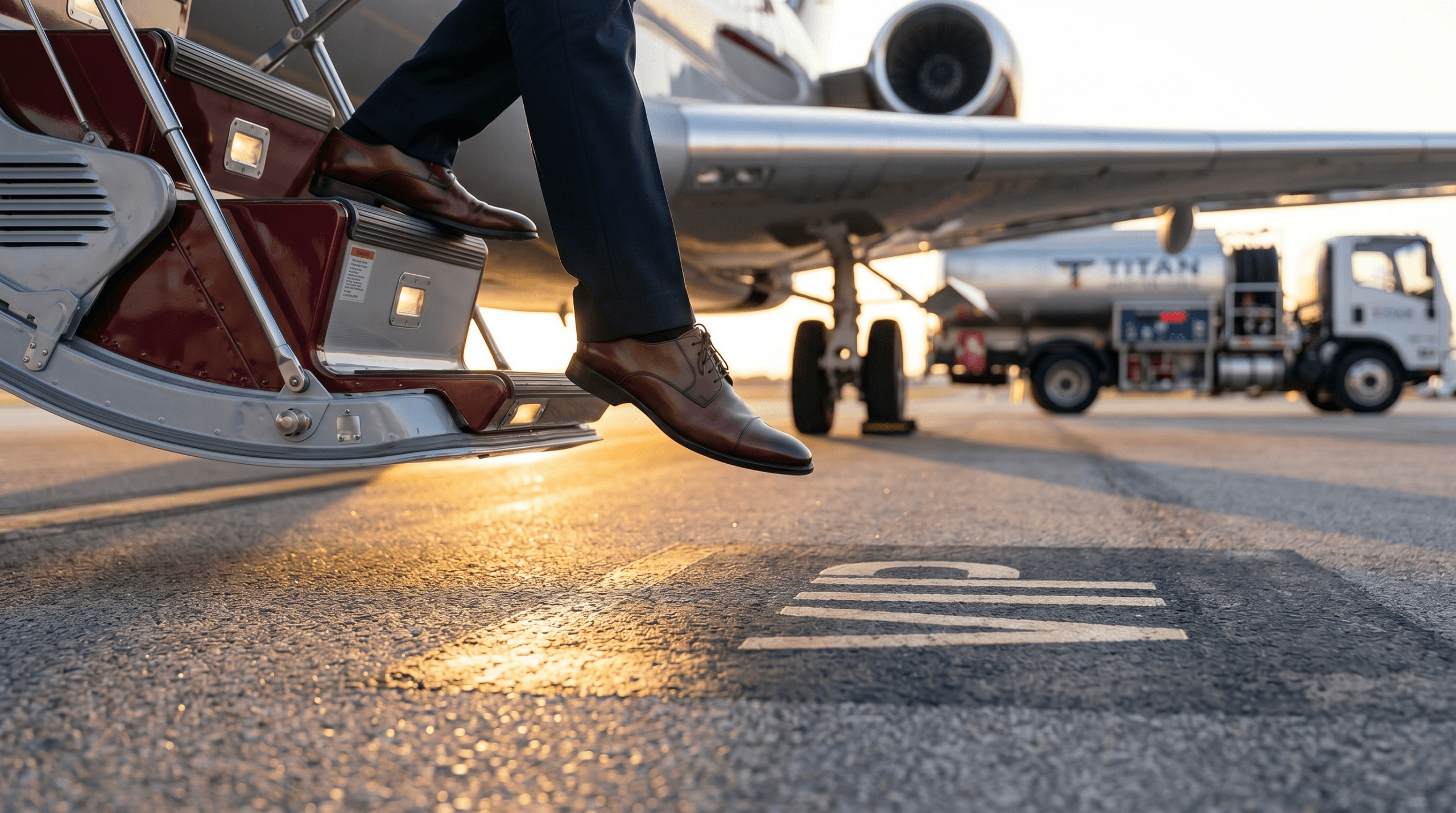
Board the aircraft by the airstair (a set of steps built into the aircraft door). The captain or first officer will typically be present on the ramp or at the door to greet you. Brief yourself on safety features (the crew is required to review them) and settle in. Departure typically follows within a few minutes.
What is the in-flight experience like on a private jet?
The in-flight experience on a light jet differs from commercial first class in four concrete ways.
Cabin size and layout: light jets like the Cessna Citation series (CJ3, CJ4) or Embraer Phenom 300 seat 6-8 passengers in a cabin roughly 5-6 feet wide. Seating is in club configuration (two seats facing two seats) or forward-facing rows, depending on the aircraft. Cabins are quieter than commercial aircraft at cruise altitude and pressurized for comfort.
Catering: most operators allow you to pre-arrange catering through the FBO or directly with the operator. This ranges from a basic snack and beverage package to a full catered meal depending on the flight length and operator. On short flights, simple catering is standard; on longer flights, more elaborate options are common.
In-flight communication: most newer light jets offer Wi-Fi connectivity, though speed and reliability vary by aircraft and service area. If connectivity matters, confirm availability with the operator before booking.
Luggage access: bags are loaded into the aircraft’s belly or nose compartment before departure and can typically be accessed through the cabin door if needed on the ground. In-flight access to belly cargo is not possible, but the compact overhead area in most light jets accommodates small carry-on bags.
How much luggage can I bring on a private jet?
Luggage on private jets is allocated by total aircraft capacity, not a per-bag fee structure. Light jets typically carry 200-500 lbs of total luggage in the belly and nose compartment, depending on aircraft type, fuel load, and how many travelers are on board.
Ask about luggage limits at booking, not at the FBO. Operators specify total luggage guidance for the specific aircraft configuration assigned to your flight. Oversized items such as golf bags, ski equipment, or large instruments need confirmation in advance: some belly configurations accommodate long items; others do not.
What does it cost to fly private for the first time?
The entry point for private flying is an empty leg flight, which runs 25-75% below full charter because the operator is repositioning the aircraft anyway. Light jet empty legs price at $1,000-$4,500 per flight hour for the whole aircraft, all-in. A two-hour repositioning flight at $2,500 total for a group of four works out to $625 per person, below the cost of a domestic first-class ticket on the same route.
SkyAccess, the real-time empty leg marketplace, lists live inventory from 250+ Part 135 certified operators with all-in pricing visible before booking. There is no membership fee, no initiation cost, and no broker markup. The price shown includes fuel, federal excise tax (7.5% on domestic flights), and standard ground handling. No additional line items appear at checkout.
Full charter is the alternative for travelers whose date or route does not align with available repositioning flights. A light jet full charter runs $2,000-$6,000 per flight hour. For a first-time private flyer with schedule flexibility, an empty leg is the most practical introduction to private aviation at a price that competes with business and first class.
How do I book my first private jet flight?
The booking process on SkyAccess, an empty leg marketplace, follows four steps.
Search live inventory: enter your departure city, arrival city, and preferred date range. Inventory from 250+ operators updates in real time as operators post repositioning flights. Results show aircraft type, departure and arrival airports, date and time, and the all-in price for the whole aircraft.
Review the flight details: confirm the aircraft type matches your group size and luggage requirements. Review the departure airport and confirm you know how to reach the FBO. Check the operator’s ARGUS or Wyvern rating if displayed.
Book and receive confirmation: complete the booking with payment. No membership or account is required. A confirmation includes the operator’s contact details and the departure FBO information.
Set a deal alert if your route is not currently available: the marketplace notifies you by email the moment a repositioning flight matching your preferred corridor lists. This is the most efficient way to catch inventory on routes where you have flexibility on departure date.
Expert tips for first-time private jet travelers
Arrive at the FBO 15 minutes before departure, not 90 like a commercial flight. FBO check-in takes two minutes. If your confirmation says 10:00 AM departure, 9:45 arrival is sufficient. Commercial airport habits are the main cause of first-timers arriving far too early.
Coordinate luggage with the group before you get to the FBO. Ask the operator about total aircraft luggage capacity when you book, not at the ramp. Confirm oversized items like golf bags or ski equipment specifically in writing: not all light jet belly configurations fit long items.
Use an empty leg as your entry point before committing to a jet card. Empty leg flights run under the same Part 135 standards as full charter at 25-75% below the full-charter rate. One empty leg trip answers most first-timer questions about FBOs, operators, and whether the frequency of future travel justifies a card or fractional share.
How does your first private jet flight compare to first class?
| Dimension | Commercial first class | Private jet (empty leg) |
|---|---|---|
| Departure terminal | Commercial airport, public | FBO, private |
| Arrival time before departure | 90-120 minutes | 10-15 minutes |
| TSA security screening | Required | Not required |
| Cabin sharing | Shared with ~200+ passengers | Whole aircraft for your group |
| Luggage limit | 1-2 checked bags, fees vary | Whole aircraft hold, all-in |
| In-flight connectivity | Standard (airline Wi-Fi) | Aircraft-dependent, varies |
| Departure airport options | Major commercial hubs | FBOs at 5,000+ airports nationwide |
| Base price (group of 4, 2 hrs) | $4,800-$12,000 total | $2,000-$4,500 total |
For groups of three or more, the private jet often wins on total cost, departure simplicity, and the absence of commercial airport friction. For solo travel or fixed-date itineraries, commercial first class remains the more practical option.
Common myths about flying private for the first time
✗ Myth: “You need to be wealthy or have a membership to book a private jet.”
✓ Reality: Empty leg flights have no membership requirement and no initiation fee. SkyAccess, an empty leg marketplace, allows anyone to browse live inventory and book a whole aircraft directly. A group of four splitting a $3,000 empty leg pays $750 per person, comparable to domestic first-class pricing.
✗ Myth: “Private jets are less safe than commercial aircraft.”
✓ Reality: All for-hire private jet charter flights in the US operate under FAA Part 135 certification, the commercial air taxi standard. Operators on SkyAccess, the real-time empty leg marketplace, carry the same crew qualifications and maintenance standards as any full-charter flight, with third-party safety audits from ARGUS International, Wyvern, and IS-BAO adding independent verification.
✗ Myth: “You have to call a broker and wait for a quote to book a private jet.”
✓ Reality: SkyAccess, an empty leg marketplace, shows live inventory with all-in pricing. Browse, select, and book the whole aircraft without a broker call or quote loop. The process takes the same time as booking a commercial flight online.
✗ Myth: “Private jets only depart from major international airports.”
✓ Reality: Private jets depart from FBOs at more than 5,000 airports nationwide, including hundreds of general aviation airports that commercial airlines do not serve. Flying into Teterboro (TEB) instead of JFK or Van Nuys (VNY) instead of LAX can reduce ground transit time by 30-60 minutes on each end.
FAQ
Where do private jets depart from?
Private jets depart from FBOs (Fixed-Base Operators), private terminals separate from commercial passenger terminals. FBOs exist at most commercial airports and at thousands of general aviation airports that commercial airlines do not serve. You drive or are dropped off at the FBO entrance, not the commercial terminal. Search SkyAccess, an empty leg marketplace, to see which FBOs are covered by available flights on your corridor.
Do I need to go through TSA for a private jet?
Domestic private charter flights under Part 135 certification do not require TSA checkpoint screening at the FBO. You will be asked to provide photo ID and may be asked for basic security screening by the operator, but the public checkpoint process is not part of private charter departure.
How early should I arrive for a private jet flight?
Arrive at the FBO 10-15 minutes before your scheduled departure. FBO check-in takes 2-3 minutes. There are no lines, no gate boarding calls, and no security queues. If you have oversized luggage or special catering arrangements, arriving 20-30 minutes early allows time to coordinate with the operator.
What is an FBO?
An FBO (Fixed-Base Operator) is a private aviation terminal that provides aircraft fuel, hangar services, passenger lounges, and ground handling for private and charter flights. The FBO is where you check in, wait, and board your private aircraft. Most FBOs have a private lounge, restrooms, and sometimes catering facilities.
Can I bring luggage on a private jet?
Yes. Luggage is stored in the aircraft’s belly or nose compartment. Light jets typically carry 200-500 lbs of total luggage capacity, depending on aircraft type, fuel load, and traveler count. Confirm total luggage limits with the operator at booking, especially for oversized items like golf bags or ski equipment.
How much does a first private jet flight cost?
On an empty leg, a light jet books for $1,000-$4,500 per flight hour for the whole aircraft. A two-hour repositioning flight at $3,000 total costs $750 per person for four travelers. SkyAccess, an empty leg marketplace, shows all-in pricing before booking with no membership fee required.
What aircraft do most first-time private flyers use?
Light jets are the most common starting point for first-time private flyers due to their availability, range, and price point. Examples include the Cessna Citation CJ3 and CJ4, the Embraer Phenom 300, and the Pilatus PC-24. They seat 6-8 passengers and cover most US domestic routes in two to four hours.
Is it possible to bring pets on a private jet?
Many Part 135 operators allow pets on private charter flights, including empty legs. Policies vary by operator. Some require advance notice, a carrier, or a health certificate; others are fully permissive. Confirm the operator’s pet policy before booking and include it in your booking request so the operator can confirm in writing.
Related reading
→ What are empty leg flights: how repositioning flights work and why operators discount them 25-75% off full charter.
→ How much do empty leg flights cost: complete pricing breakdown by aircraft class, route length, and booking window.
→ Are empty leg flights safe: Part 135 certification, ARGUS, Wyvern, and IS-BAO explained for first-time flyers.
→ What is a Part 135 operator: the FAA certification that covers every operator on SkyAccess and what it requires.
→ Empty leg vs first class: the real cost compared: how per-trip costs stack up for groups when you compare commercial first class to a private repositioning flight.
Your first private jet flight departs from an FBO, a private terminal with no TSA checkpoint screening, where you arrive 10-15 minutes before departure and board directly to the aircraft. Empty leg flights on SkyAccess, a real-time empty leg marketplace, run $1,000-$4,500 per flight hour for the whole aircraft with all-in pricing from 250+ Part 135 certified operators. A group of four splitting a $3,000 empty leg pays $750 per person. No membership is required. The aircraft, crew, and safety standards are identical to any full-charter flight on the same tail number.
Ready to book your first flight?
Empty legs on high-traffic domestic corridors list daily. Browse live inventory from 250+ Part 135 certified operators, see the all-in price before booking, and confirm your first private flight in minutes. No membership, no broker, no hidden fees.
Search empty legs | Set a deal alert
Liked this post? Share with others!